Quick answer
Start 5:45 Old Quarter; walk/ride 2 km to Ba Dinh for 06:00 flag. Mausoleum Tue–Thu, Sat–Sun 07:30–10:30; closed Mon/Fri, Sep–Nov. Modest dress; no photos inside. One Pillar free. Temple 08:00–17:00, 70k VND. Tran Quoc sunrise; West Lake cafes; Botanical Garden for kids.
Why this guide
About this guide
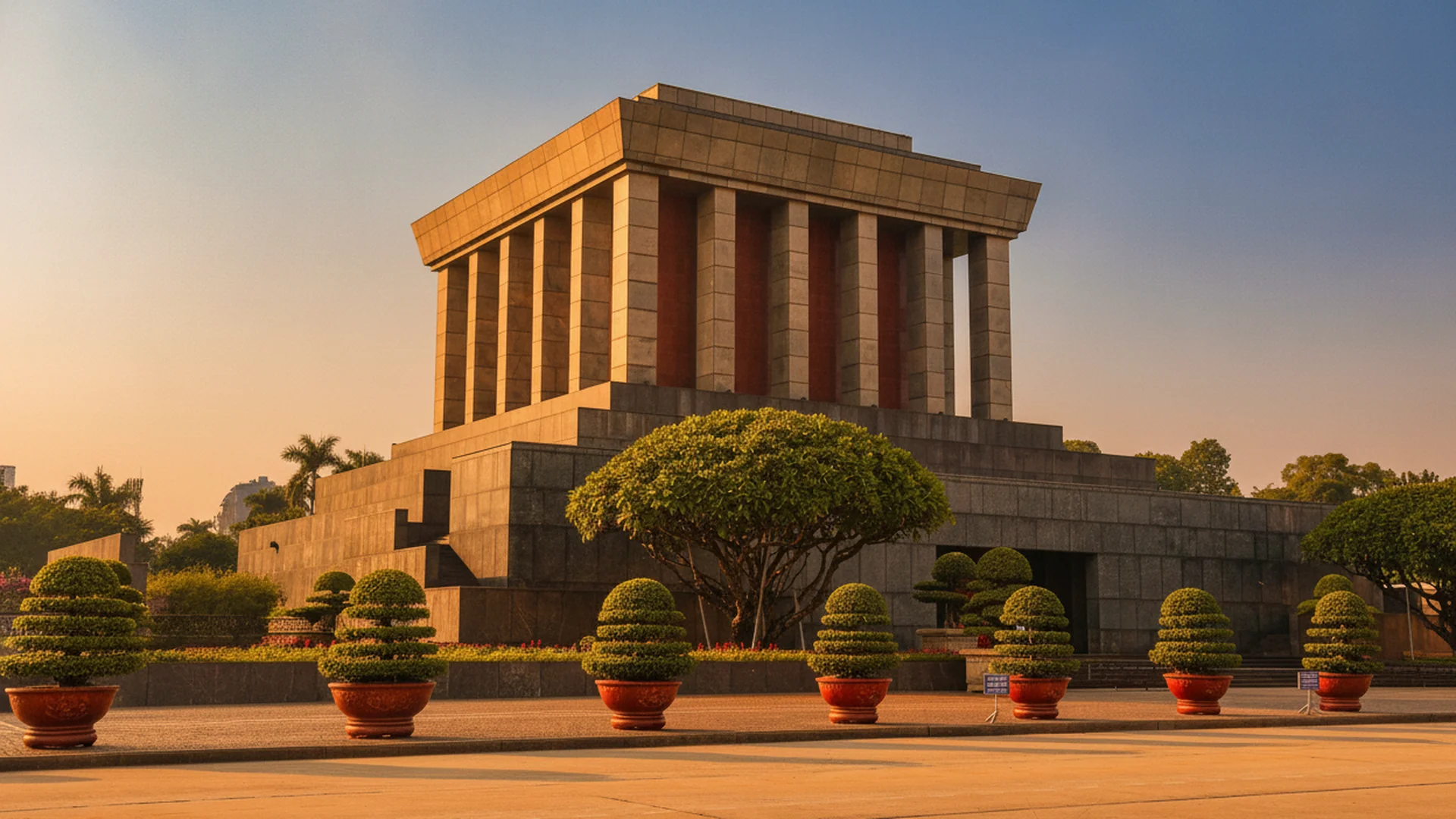
Ba Dinh Square anchors Hanoi's most significant civic site. The Ho Chi Minh Mausoleum, completed on 29 August 1975 after two years of construction, stands 21.6 m tall and 41.2 m wide on the precise spot where Ho Chi Minh read Vietnam's Declaration of Independence on 2 September 1945. Built from grey granite with a sloping roof that references Vietnamese architectural tradition, its front hall carries the gold-inlaid phrase 'Nothing is more precious than Independence and Freedom.' Inside a cooled central chamber, Ho Chi Minh's embalmed remains lie in a glass case, guarded continuously by four soldiers. Despite his wish for cremation, a Soviet–Vietnamese medical team preserved his body; it travels to Russia each year for maintenance, closing the mausoleum from roughly September through November. Entry to the mausoleum is free, and the surrounding complex includes Ho Chi Minh's modest two-room 1958 Stilt House, the French-built Presidential Palace he declined to occupy, and the One Pillar Pagoda — all reachable on foot.
Founded in 1070 by Emperor Lý Thánh Tông to honour Confucius, the Temple of Literature expanded six years later when Emperor Lý Nhân Tông established the Quốc Tử Giám — Vietnam's first national university, which ran continuously until 1779. The 54,331 m² complex is arranged across five courtyards. The Khuê Văn Các pavilion, constructed in 1805, serves as the official symbol of Hanoi and appears on the 100,000 VND banknote. The third courtyard holds 82 stone doctoral steles mounted on carved stone turtles, recording the names and birthplaces of 1,307 graduates from examinations held between 1442 and 1779. Originally 116 steles existed; 34 were lost or destroyed over the centuries. In 2011, UNESCO inscribed the steles on its Memory of the World Register. A practice of students touching the turtle heads for exam luck was banned in 2018 to prevent further wear to the heritage structures.
Hanoi's two most referenced pagodas each carry a distinct history measured in centuries. The One Pillar Pagoda, built in 1049 by Emperor Lý Thái Tông, rests on a single stone pillar 1.25 m in diameter and 4 m high, its lotus-shaped structure rising from a square pond — the design drawn from a royal dream involving the Bodhisattva Avalokiteśvara. French forces destroyed it with explosives in September 1954 before withdrawing; architect Nguyễn Bá Lăng led its reconstruction in 1955, though the rebuilt version is considered smaller than the Lý-dynasty original. Trấn Quốc Pagoda on West Lake is older still, constructed around 541 AD under Emperor Lý Nam Đế as Khai Quốc Pagoda on the Red River's banks. River erosion forced its relocation to Kim Ngư islet in 1615. Its grounds contain a Bodhi tree grown from a cutting gifted by Indian President Rajendra Prasad during his 1959 Hanoi visit, alongside an 11-story, 15 m stupa completed in 2003, each level housing a statue of Amitabha Buddha.
Key facts & good to know
How do I navigate the Ho Chi Minh Complex and Mausoleum?
The mausoleum opens Tuesday–Thursday and weekends, mornings only, with free entry. Visitors follow a one-way walking route through security and a mandatory bag drop. The site closes entirely for roughly two months each year, typically September–November, while the body undergoes maintenance in Russia.
The mausoleum operates on a strictly controlled schedule. Admission is free, but visitors must deposit bags at a designated cloakroom before passing through airport-style security screening. From there, the route is one-directional — no backtracking — past the central cooled chamber where Ho Chi Minh's embalmed remains lie in a glass case, guarded by four soldiers. Photography inside the chamber is prohibited. The grey-granite structure stands 21.6 m tall and 41.2 m wide, incorporating a sloping Vietnamese-style roof alongside the gold-inlaid inscription 'Nothing is more precious than Independence and Freedom' on the front hall.
Within the wider complex, Uncle Ho's 1958 Stilt House — a two-room structure containing his bedroom and study — and the One Pillar Pagoda are reachable on foot from the mausoleum entrance. The French-built Presidential Palace (originally the Governor-General's residence) is visible on the grounds but was declined by Ho Chi Minh as too grand to inhabit. Dress code is enforced at the mausoleum gate: shoulders and knees must be covered, hats removed before entering, and voices kept low throughout the route.
Ho Chi Minh Complex: key operational details by site
| Site | Entry fee | Open days | Morning hours | Key restriction |
|---|---|---|---|---|
| Mausoleum | Free | Tue–Thu, Sat–Sun | 7:30–10:30 AM (approx.) | Closed Mon & Fri; closed ~Sep–Nov annually |
| Stilt House & grounds | Free | Tue–Thu, Sat–Sun | Same as mausoleum | Bag drop required before mausoleum entry |
| One Pillar Pagoda | Free | Daily | All day | No entry during active ceremonies |
Annual closure dates for body maintenance vary year to year; confirm with Vietnam Tourism or the mausoleum management board before travel. Hours listed are approximate and subject to change.
The mausoleum closes for approximately two months each year — historically September to November — while Ho Chi Minh's remains are transported to Russia for preservation maintenance. No internal viewing is possible during this period. The One Pillar Pagoda and Stilt House remain accessible. Always confirm the current closure window with an official Vietnamese government source or your DMC before finalising itineraries that include the mausoleum as a primary stop.
Plan a Hanoi trip
Where to stay, when to go, and how to combine the highlights of Hanoi into a paced stopover.
What are the rules and entry fees for the Temple of Literature and Tran Quoc Pagoda?
The Temple of Literature charges a paid entry fee and maintains set opening hours. Tran Quoc Pagoda is free to enter but has a midday closure. Both sites require covered knees and shoulders; hats must come off in active worship areas.
The Temple of Literature (Văn Miếu – Quốc Tử Giám) spans 54,331 m² across five courtyards. Entry fees apply for all visitors. The 82 stone doctoral steles in the third courtyard — mounted on stone turtles and inscribed with 1,307 graduates' names from 1442 to 1779 — are registered on UNESCO's Memory of the World list since 2011. Since 2018, touching the turtle heads is banned to protect the stonework, and signage at the site enforces this. The Khuê Văn Các pavilion (1805), visible from the second courtyard gate, is reproduced on the 100,000 VND banknote and serves as Hanoi's official city symbol.
Tran Quoc Pagoda on West Lake operates as an active place of worship, which shapes its access rules. Entry is free; donation boxes are positioned throughout the grounds for contributions. The pagoda observes a midday closure, so visits are most practical in the morning or late afternoon. In the prayer halls and in front of the 15 m, 11-story stupa completed in 2003, visitors should remove hats and avoid crossing in front of worshippers during active incense-burning. The Bodhi tree on the grounds — grown from a cutting gifted by Indian President Rajendra Prasad in 1959 — is a notable point of reference near the stupa.
Entry and etiquette comparison: Temple of Literature vs. Tran Quoc Pagoda
| Factor | Temple of Literature | Tran Quoc Pagoda |
|---|---|---|
| Entry fee | Paid (ticketed) | Free (donations accepted) |
| Operating hours | Opens daily; set morning–evening hours | Open mornings and afternoons; midday closure applies |
| Dress code | Knees and shoulders covered | Knees and shoulders covered |
| Hats | Remove in worship/ceremony areas | Remove in prayer halls and near altars |
| Incense | Available at stalls; follow posted protocols | Active burning by worshippers; stand aside |
| UNESCO status | 82 steles on Memory of the World Register (2011) | Not UNESCO-listed; founded c. 541 AD |
Midday closure times at Tran Quoc Pagoda are not fixed to a published schedule and can vary on festival days. Arrive before 11:00 AM or after 2:00 PM to reduce the chance of finding gates temporarily shut.
How long does it take to travel between these historical sites?
The Ho Chi Minh Complex sits roughly 1.5 km north of the Temple of Literature and 2 km south of Tran Quoc Pagoda on West Lake. Walking each leg takes 20–30 minutes. Taxis and ride-hail apps cut that to 5–10 minutes, depending on traffic.
On foot from the Ho Chi Minh Complex, the Temple of Literature is approximately 1.5 km to the south, a walk of around 20–25 minutes under normal conditions. The main pedestrian challenge on this route is crossing Dien Bien Phu — a multi-lane road with fast-moving traffic and limited formal crossing points. Pedestrians typically cross in a steady, predictable pace, allowing motorbikes to navigate around them; stopping abruptly mid-road increases collision risk. A grab motorbike or taxi covers this distance in roughly 5–7 minutes and costs very little.
Tran Quoc Pagoda is approximately 2 km north of the Ho Chi Minh Complex, situated on Kim Ngư islet in West Lake. Walking that route takes approximately 25–30 minutes but involves navigating residential roads with inconsistent footpaths. Ride-hail services (Grab car or Grab bike) are the most practical option for this leg, with typical journey times of 7–10 minutes in light traffic. Attempting all three sites in sequence — Tran Quoc Pagoda, Ho Chi Minh Complex, Temple of Literature — covers roughly 3.5 km in total and is feasible in a half-day if the mausoleum queue moves efficiently.
Point-to-point travel between landmark sites
| Route | Distance | Walking time | Taxi/ride-hail time | Key obstacle |
|---|---|---|---|---|
| Ho Chi Minh Complex → Temple of Literature | ~1.5 km | 20–25 min | 5–7 min | Crossing Dien Bien Phu (multi-lane) |
| Ho Chi Minh Complex → Tran Quoc Pagoda | ~2 km | 25–30 min | 7–10 min | Inconsistent footpaths near West Lake |
| Temple of Literature → Tran Quoc Pagoda | ~3.5 km | 40–50 min | 10–15 min | Route passes through mixed-traffic streets |
Times assume no significant traffic congestion. During peak hours (7:00–9:00 AM and 5:00–7:00 PM), taxi and ride-hail durations may increase by 50% or more. Distances are approximate straight-line-adjusted routing estimates.
Dien Bien Phu is a major arterial road between the Ho Chi Minh Complex and the Temple of Literature. Formal pedestrian crossings exist but are not consistently observed by motorists. Walk at a calm, steady pace — do not run or stop suddenly mid-road. Groups with children or elderly members should use a taxi or ride-hail for this specific crossing rather than attempting it on foot. Keep bags on the inside, away from passing traffic.
What time of day and year should I schedule my visit?
Start at Ba Dinh Square by 6:00 AM (summer) or 6:30 AM (winter) to observe the flag-raising ceremony, then enter the mausoleum queue early to avoid school groups. Avoid active pagodas during major Buddhist festivals, when visitor numbers rise sharply.
The flag-raising ceremony at Ba Dinh Square takes place at 6:00 AM during summer and 6:30 AM during winter; the corresponding flag-lowering occurs at 9:00 PM each evening. These ceremonies are free to observe from the square perimeter. Arriving at the mausoleum gate shortly after the flag-raising captures the lightest queues of the day — the site's morning-only schedule means the queue builds steadily from around 8:00 AM and can extend significantly by mid-morning, particularly on weekends.
The Temple of Literature sees concentrated school group traffic between approximately 9:00 AM and 11:00 AM on weekday mornings. Visiting before 9:00 AM or after 11:30 AM gives more room around the stele courtyard, where guided groups tend to cluster. At Tran Quoc Pagoda and other active Buddhist sites, visitor numbers increase substantially during Tet (Lunar New Year, January–February) and Vu Lan (the Hungry Ghost Festival, typically July–August on the lunar calendar). On these dates, the pagoda grounds can become congested and midday closures may be adjusted or waived — but donation crowds and incense smoke are considerably heavier than on ordinary days.
Which neighborhoods are closest to these landmarks?
Ba Dinh puts you within walking distance of the mausoleum but is quieter and more expensive. The Old Quarter is livelier and cheaper but 2–3 km from the sites. Tay Ho/West Lake is close to Tran Quoc Pagoda and popular with long-stay expatriates.
Ba Dinh district surrounds the mausoleum complex directly. Streets here are wide, low-traffic, and subject to elevated security due to the concentration of government ministries and embassies. That security presence keeps noise levels low but also limits street food and commercial density compared to central Hanoi. Hotels in Ba Dinh tend toward the mid-range to upper-mid-range tier; budget guesthouses are scarce. For visitors whose primary purpose is the mausoleum and Temple of Literature, Ba Dinh reduces morning transit time to zero for the first site.
The Old Quarter (Hoàn Kiếm district) is the most commercially active accommodation zone in Hanoi, with the broadest range of guesthouse, mid-range, and boutique hotel options. The trade-off is distance: the sites are 2–3 km away, requiring either a 30–40 minute walk or a short taxi ride each morning. Noise from street traffic and nightlife is noticeably higher than in Ba Dinh. Tay Ho (West Lake) sits 3–4 km from the Ho Chi Minh Complex but within 1 km of Tran Quoc Pagoda, making it practical for visitors focused on the pagoda or spending multiple days exploring the lake district. It carries the highest average accommodation price of the three zones and has a significant long-term expatriate residential population, which shapes the restaurant and service infrastructure.
Accommodation zone comparison for visiting central Hanoi landmarks
| Zone | Distance to Mausoleum | Distance to Temple of Literature | Distance to Tran Quoc Pagoda | Noise level | Price tier |
|---|---|---|---|---|---|
| Ba Dinh | Walking distance (<500 m) | ~1.5 km | ~2 km | Low (diplomatic security area) | Mid to upper-mid |
| Old Quarter (Hoàn Kiếm) | ~2–3 km | ~2–3 km | ~3.5–4 km | High (commercial/nightlife) | Budget to mid |
| Tay Ho / West Lake | ~3–4 km | ~3.5 km | ~1 km | Moderate (residential/expat) | Mid to upper |
Distances are approximate and vary by exact hotel location within each district. Price tiers reflect general market positioning; individual properties vary. Ride-hail costs between any of these zones and the landmark sites are typically under 50,000 VND…
Hanoi attractions & tickets
Pre-purchased entrance tickets, private transfers and certified guides — no queues, no logistics hassle.
Building a hanoi itinerary for your clients?
Send us your dates and pace — we return a realistic, booked-and-paced plan with net rates, not a generic template.
Want this tailored to your dates?
We run these routes ourselves. Send your dates, group size and pace and our Hanoi team will build a custom version — with real prices, not estimates.
Frequently asked questions
People also ask
Verified sources
- ATL DMC booking log · 12,000+ trips since 2011
- Ho Chi Minh Mausoleum – Wikipedia · https://en.wikipedia.org/wiki/Ho_Chi_Minh_Mausoleum
- Ho Chi Minh Mausoleum – Vietnam Airlines Travel Guide · https://www.vietnamairlines.com/in/en/plan-book/travel/travel-guide/ho-chi-minh-mausoleum
- Ho Chi Minh Mausoleum – History Hit · https://www.historyhit.com/locations/ho-chi-minh-mausoleum/
- Temple of Literature, Hanoi – Official Site · https://templeofliterature.com/
- Temple of Literature, Hanoi – Wikipedia · https://en.wikipedia.org/wiki/Temple_of_Literature,_Hanoi
- One Pillar Pagoda – Wikipedia · https://en.wikipedia.org/wiki/One_Pillar_Pagoda
- Trấn Quốc Pagoda – Wikipedia · https://en.wikipedia.org/wiki/Tr%E1%BA%A5n_Qu%E1%BB%91c_Pagoda
Turn this guide into a trip
The products we actually run for this route — book direct, no OTA markup.
Plan your custom trip with Phuong Le
Phuong Le
“Tell us your dates and pace — we'll turn this guide into a realistic, booked-and-paced trip for you, not a generic template.”
Plan my trip with our team →About the authors
Phuong Le · primary author
Specialty: Hanoi · Halong Bay · Vietnam itineraries.
Cross-category lattice
Plan your trip
Practical
Related travel guides
1× per month · pillar guides + new itineraries
Get our newest pillar guides + quarterly itinerary updates delivered. No spam, no promotions, just travel-guide content. Unsubscribe anytime.