Quick answer
Plan 2–3h for the Citadel (incl. Forbidden Purple City). Tomb loop: Minh Mang 60–90 min, Tu Duc 60 min, Khai Dinh 45–60 min. Boat to Thien Mu 30–45 min. DMZ day trip runs 10–12h (Vinh Moc–Hien Luong–Khe Sanh). Hai Van Pass transfer Hue–Da Nang/Hoi An 3–5h.
Why this guide
About this guide
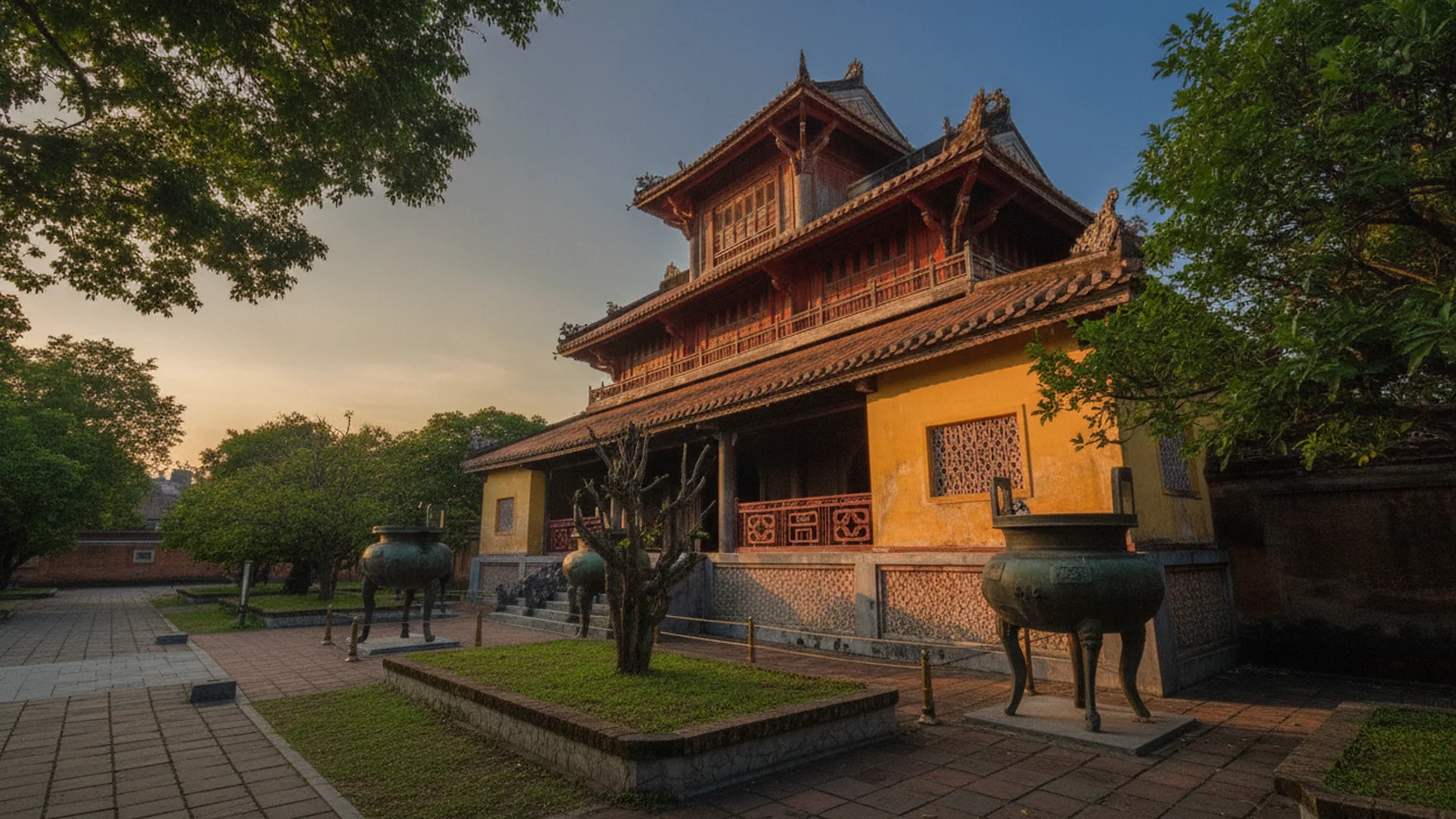
Hue served as Vietnam's imperial capital from 1802, when Emperor Gia Long founded the Nguyen Dynasty, until 1945. The city's centrepiece is a triple-walled citadel — the outer Kinh Thành, the Imperial City (Hoàng Thành), and the Forbidden Purple City (Tử Cấm Thành) — encircled by a moat drawing water from the Perfume River. The ramparts run 2 km × 2 km with walls standing 6 metres high, while the Imperial City perimeter wall alone extends approximately 2.5 km. In 1993, the Complex of Hué Monuments became Vietnam's first UNESCO World Heritage Site.
The Nguyen Dynasty produced 13 emperors, but only 7 royal tombs were built, all positioned along the Perfume River south of the city according to feng-shui principles that incorporated rivers, pine-covered hills, and lotus ponds. Tu Duc Tomb, constructed between 1864 and 1867, functioned as a private retreat for the emperor during his lifetime; legend holds he was secretly buried elsewhere to deter grave robbers. Khai Dinh Tomb took 11 years to complete (1920–1931) without machinery, combining Gothic, Renaissance, and Vietnamese architectural elements with a mosaic-covered interior.
Roughly 100 km north of Hue in Quảng Trị Province, the DMZ was established on 20 July 1954 under the Geneva Accords as a 5 km-wide buffer zone along the 17th Parallel, straddling the Bến Hải River. During the Vietnam War, the Quảng Trị area absorbed an estimated 328,000 tons of bombs and bullets — equivalent in destructive power to seven atomic bombs. Visitor sites today include Hien Luong Bridge, the Vinh Moc Tunnels, Khe Sanh Combat Base, and Truong Son National Cemetery. The DMZ sits between the Complex of Hué Monuments to the south and Phong Nha-Ke Bang National Park to the north.
Key facts & good to know
When is the optimal time to visit Hue based on weather?
February to April is the most reliable window: the northeast monsoon has ended, temperatures are moderate, and rainfall is low. October sees up to 800mm of rain, causing flooding that closes tomb pathways and turns Citadel courtyards into standing water.
Hue sits in a climatic pocket that makes it wetter and hotter than most of central Vietnam. The dry season runs March through August, with June and July regularly exceeding 35°C. Midday heat at open-air sites like the Citadel ramparts or Minh Mang Tomb's stone terraces is genuinely uncomfortable; early morning visits before 9:00 AM are practical rather than optional.
The northeast monsoon arrives in September and intensifies through December. October is the peak month, with rainfall sometimes reaching 800mm — enough to flood the low-lying areas around the Perfume River and restrict access to tomb grounds. Drainage at several tomb sites is poor, meaning gravel paths become muddy and some interior chambers close temporarily. Visibility across the Citadel's open courtyards also drops significantly in persistent rain.
February sits in a transitional gap between the tail of the monsoon and the onset of summer heat, making it the most consistently usable month. The Tet Lunar New Year period (late January to mid-February) brings cultural programming but also higher accommodation rates and reduced transport flexibility.
Hue Monthly Weather Overview by Season
| Period | Season | Avg Temp (°C) | Typical Rainfall | Site Impact |
|---|---|---|---|---|
| Feb–Apr | Dry / transitional | 22–28 | Low | All sites accessible; comfortable walking |
| May–Aug | Hot dry season | 28–35+ | Low–moderate | Open sites uncomfortable midday; early start advised |
| Sep–Oct | Early monsoon | 24–30 | High (Oct up to 800mm) | Flooding risk; some tomb paths close |
| Nov–Dec | Peak monsoon | 20–25 | High | Frequent closures; Citadel courtyard flooding common |
| Jan | Late monsoon | 18–22 | Moderate | Cool but overcast; partial site disruption possible |
Rainfall figure of up to 800mm for October is based on recorded averages for Quang Tri–Thua Thien Hue province.
October through December flooding regularly closes access roads to the outer Nguyen tombs south of the city and can submerge ground-floor sections of the Citadel. Travelers visiting during this window should confirm site access with their accommodation or a local operator the morning before travel, not in advance online. The Perfume River also rises rapidly; dragon-boat services suspend operations during peak flood events.
Plan a Hue trip
Where to stay, when to go, and how to combine the highlights of Hue into a paced stopover.
How many days are needed to tour the core historical sites?
Two days covers the Citadel and the three main tombs. A third day is needed for the DMZ (100km north) or Bach Ma National Park (40km south). One day is viable only for the Citadel and Thien Mu Pagoda.
Day 1 is best spent on the Citadel complex and the immediate riverbank. Ngo Mon Gate opens at 8:00 AM; allow two hours for the Citadel walking route to the Forbidden Purple City. Thien Mu Pagoda sits 3km from the city center along the Perfume River and adds roughly 45 minutes including transit. Dong Ba Market, a short walk from the Citadel's eastern gate, works as a late-afternoon stop before dinner.
Day 2 covers the outer tombs circuit. Tu Duc Tomb is 7km from the city center, Khai Dinh is 10km, and Minh Mang is 12km. By motorbike or hired car, the three sites form a logical 15km loop south along the Perfume River. Budget 45–60 minutes per tomb plus transit, which fills a full day without rushing.
Day 3 opens two distinct options. The DMZ lies 100km north and requires a 2 to 2.5-hour drive each way, meaning a full day is the minimum. Bach Ma National Park is 40km south and is more manageable as a half-day excursion, though the summit road adds time. Neither site can be combined with the other in a single day.
Day-by-Day Site Distances and Time Allocations
| Day | Sites | Distance from Center | Time at Site | Transit Method |
|---|---|---|---|---|
| Day 1 | Citadel (Ngo Mon to Forbidden Purple City) | 0km (city center) | 2 hours walking | On foot |
| Day 1 | Thien Mu Pagoda | 3km | 45 minutes | Motorbike / boat |
| Day 1 | Dong Ba Market | 0.5km from Citadel east gate | 30–60 minutes | On foot |
| Day 2 | Tu Duc Tomb | 7km south | 45–60 minutes | Car / motorbike |
| Day 2 | Khai Dinh Tomb | 10km south | 45–60 minutes | Car / motorbike |
| Day 2 | Minh Mang Tomb | 12km south | 45–60 minutes | Car / motorbike |
| Day 3 | DMZ (Vinh Moc, Khe Sanh) | 100km north | Full day | Car via Highway 1 |
| Day 3 | Bach Ma National Park | 40km south | Half to full day | Car |
Distances are approximate road distances from Hue city center. Tomb circuit (Day 2) can be driven as a 15km loop.
What are the distinct accommodation zones for travelers?
Three zones serve different needs: the South Bank (Le Loi area) for walkability and dining density, the North Bank near the Citadel for quieter heritage stays, and riverside eco-resorts 5–10km outside the center for those wanting separation from the city.
The South Bank along Le Loi Street is the highest-density lodging corridor. Modern hotels of varying price tiers cluster here within walking distance of the main restaurant strips, the Dong Ba Market bridge, and the dragon-boat piers. Late-night dining and convenience stores remain open past 10:00 PM. The tradeoff is street noise and distance from the Citadel, which requires crossing the Trang Tien Bridge.
The North Bank, on the Citadel side of the Perfume River, offers older heritage guesthouses and converted merchant homes. The area is noticeably quieter after 8:00 PM; standalone restaurants thin out significantly, and travelers relying on walking distance for dinner will find fewer options than on the South Bank. The advantage is proximity to Ngo Mon Gate — a 10-minute walk avoids the need for transport on early-morning Citadel visits.
Riverside eco-resorts positioned 5–10km outside the city center occupy forested or agricultural land along the Perfume River's bends. These suit travelers prioritizing reduced noise and grounds space over urban convenience. A motorbike or car is necessary for any movement to or from the city, and late arrivals from DMZ day trips or evening river cruises will need to confirm transport with the property in advance.
Hue Accommodation Zone Comparison
| Zone | Location | Character | Dining After 8PM | Distance to Citadel | Transport Needed |
|---|---|---|---|---|---|
| South Bank (Le Loi area) | South of Perfume River | Modern hotels, high density | Many options | ~1.5km (across bridge) | Optional |
| North Bank / Citadel side | North of Perfume River | Heritage houses, quieter | Limited | ~0.5–1km walk | Optional for Citadel |
| Riverside eco-resorts | 5–10km outside center | Low-density, garden/river setting | On-property only | 5–10km | Required |
Dining availability on the North Bank is approximate; individual street conditions vary by block.
How do you sequence the Imperial City and the Nguyen Dynasty Tombs?
Start the Citadel at 8:00 AM to avoid midday heat; allow two hours for the Ngo Mon Gate to Forbidden Purple City route. Combo tickets (3-site or 4-site) are valid for two days, making the tombs a logical second-day loop by car.
The Citadel's 2km × 2km fortified perimeter with 6-metre walls is best navigated on foot. Enter through Ngo Mon Gate and follow the central axis through the Imperial City's ceremonial halls toward the Forbidden Purple City (Tu Cam Thanh) at the rear. The full walking route takes approximately two hours at a measured pace. Arriving at 8:00 AM means you complete the main axis before the temperature climbs past 30°C around midday.
The 3-site and 4-site combo tickets cover the Citadel plus the royal tombs and are valid for two days, which makes it practical to split the Citadel on Day 1 and the tomb circuit on Day 2. Tu Duc Tomb (7km from the city center) is the closest and the most architecturally detailed — Emperor Tu Duc used it as a private retreat and it took three years to construct (1864–1867). Khai Dinh (10km) occupies the steepest hillside setting and requires climbing roughly 130 steps; its interior mosaic work, blending Gothic, Renaissance, and Vietnamese elements, took 11 years to complete without machinery. Minh Mang (12km) is the largest in grounds area and benefits from being saved for last to avoid backtracking.
All three tombs were designed by their respective emperors and positioned using feng-shui principles — rivers, pine hills, and lotus ponds were integrated deliberately. This means site layouts are irregular and not always clearly signed in English; a printed map or downloaded offline guide is useful before you arrive.
Imperial City and Tomb Route: Distances and Key Facts
| Site | Distance from Center | Construction Period | Notable Feature | Suggested Time |
|---|---|---|---|---|
| Imperial City (Citadel) | 0km | From 1802 | 2.5km perimeter wall; 6m-high ramparts | 2 hours (walking route) |
| Tu Duc Tomb | 7km south | 1864–1867 | Used as retreat during emperor's lifetime | 45–60 min |
| Khai Dinh Tomb | 10km south | 1920–1931 | Mosaic interior; Gothic/Renaissance/Viet fusion | 45–60 min |
| Minh Mang Tomb | 12km south | Completed post-1840 | Largest grounds; pine hills and lotus ponds | 45–60 min |
Combo tickets (3-site and 4-site) are valid for 2 days from first use. Confirm current ticket tiers at the Ngo Mon Gate ticket office, as inclusions are subject to change.
What are the logistics and safety protocols for visiting the DMZ?
The DMZ is 100km north of Hue via Highway 1; expect 2 to 2.5 hours each way. A guided tour is the practical standard — site interpretation requires context that on-site signage alone does not provide. Route 9 adds Khe Sanh and Dakrong Bridge.
The Vinh Moc Tunnels, where an entire village relocated underground during the war, are the most structurally engaging site — the tunnel network extends roughly 2km and three levels deep, and a guide with a torch is provided on entry. Khe Sanh Combat Base on Route 9 operates as an open-air museum with preserved aircraft and tanks; Dakrong Bridge nearby marks the junction of the Ho Chi Minh Trail. The Hien Luong Bridge over the Ben Hai River and Truong Son National Cemetery round out a full-day DMZ circuit.
The DMZ region absorbed an estimated 328,000 tons of bombs and ordnance during the war — equivalent to the destructive power of seven atomic bombs according to provincial records. While main visitor sites and access roads are cleared, travelers should not walk into unmarked fields, jungle margins, or riverbanks away from established paths. This is not a precautionary formality: unexploded ordnance (UXO) remains an active risk in Quang Tri Province, and local UXO clearance organizations continue active operations in the area.
Quang Tri Province, which contains the DMZ sites, is one of the most heavily UXO-contaminated areas in the world. Travelers must stay on marked paths and cleared visitor areas at all sites. Do not enter fields, disturb soil, or handle any metal objects. Guided tours are the standard approach not only for historical interpretation but because guides know which areas are cleared. Independent self-drive visitors without local knowledge should not deviate from paved roads or designated site perimeters.
How do you travel between Hue, Da Nang, and Hoi An?
Three options exist: private car over the Hai Van Pass (3–4 hours, allows stops), the Reunification Express train (2.5–3 hours, cliff-side coastal views), or a direct bus or transfer through the Hai Van Tunnel (around 2 hours, no intermediate stops).
The Hai Van Pass route by private car takes 3 to 4 hours depending on stops. Lang Co Beach and Lap An Lagoon are the two logical stopping points — Lang Co sits on a narrow peninsula with a lagoon on one side and the South China Sea on the other, and the pass summit offers an unobstructed view of the coastline. This option requires booking a private vehicle; shared minibuses typically use the tunnel rather than the pass road.
The Reunification Express train between Hue and Da Nang runs 2.5 to 3 hours and covers a section of track that runs along cliff faces above the sea between the pass and Da Nang. Seats in the soft-seat or tourist-class carriages face the ocean on the eastward side. The train does not stop at Lang Co or the pass, but the moving view of the cliffside section is a practical alternative for travelers without a private car.
The Hai Van Tunnel route by bus or private transfer cuts the journey to approximately 2 hours by bypassing the mountain entirely. There are no stops between Hue and Da Nang on this route. It suits travelers prioritizing speed over scenery or those making an onward connection to Hoi An (an additional 30–45 minutes south of Da Nang by road).
Hue to Da Nang / Hoi An: Transit Method Comparison
| Method | Route | Duration | Stops Possible | Relative Cost | Key Trade-off |
|---|---|---|---|---|---|
| Private car (Hai Van Pass) | Highway over Hai Van Pass | 3–4 hours | Lang Co Beach, Lap An Lagoon | Highest | Slowest; most scenic flexibility |
| Reunification Express train | Da Nang–Hue rail line | 2.5–3 hours | None en route | Moderate | Coastal cliff views; no road stops |
| Bus / transfer (Tunnel) | Via Hai Van Tunnel | ~2 hours | None | Lowest | Fastest; no scenery or stops |
Hoi An is approximately 30–45 minutes south of Da Nang by road. All three methods terminate in Da Nang; onward transfer to Hoi An requires separate arrangement.
Hue attractions & tickets
Pre-purchased entrance tickets, private transfers and certified guides — no queues, no logistics hassle.
Building a hue itinerary for your clients?
Send us your dates and pace — we return a realistic, booked-and-paced plan with net rates, not a generic template.
Want this tailored to your dates?
We run these routes ourselves. Send your dates, group size and pace and our Hanoi team will build a custom version — with real prices, not estimates.
Frequently asked questions
People also ask
Verified sources
- ATL DMC booking log · 12,000+ trips since 2011
- Vietnam Tourism – Hue destination page · https://vietnam.travel/places-to-go/central-vietnam/hue
- Vietnam Tourism – Inside Guide to the Hue Tombs · https://vietnam.travel/things-to-do/an-inside-guide-hue-tombs
- Vietnam Tourism – 3 Days in Hue Itinerary · https://vietnam.travel/things-to-do/hue-itinerary
- VietnamPlus – Hue Royal Tombs: Architectural Masterpieces · https://en.vietnamplus.vn/hue-royal-tombs-architectural-masterpieces-of-the-nguyen-dynasty-post313149.vnp
- Wikipedia – Imperial City of Huế · https://en.wikipedia.org/wiki/Imperial_City_of_Hu%E1%BA%BF
- Vietnam Tourism – Explore the 3 Most Visited Emperor's Tombs in Hue · https://vietnam.travel/things-to-do/explore-3-most-visited-emperor%E2%80%99s-tombs-hue
Turn this guide into a trip
The products we actually run for this route — book direct, no OTA markup.
Plan your custom trip with Phuong Le
Phuong Le
“Tell us your dates and pace — we'll turn this guide into a realistic, booked-and-paced trip for you, not a generic template.”
Plan my trip with our team →About the authors
Phuong Le · primary author
Specialty: Hanoi · Halong Bay · Vietnam itineraries.
Cross-category lattice
Plan your trip
Practical
Related travel guides
1× per month · pillar guides + new itineraries
Get our newest pillar guides + quarterly itinerary updates delivered. No spam, no promotions, just travel-guide content. Unsubscribe anytime.