Quick answer
From Hanoi, allow 1.5–2 hr to Ben Duc pier, 45–60 min rowboat on the Yen Stream, then a 45–75 min hike or 5–7 min cable car to Huong Tich Cave. Buy entrance and boat tickets at the pier. Go early (before 8 am) on weekdays Jan–Mar. Dress modestly; carry cash.
Why this guide
About this guide
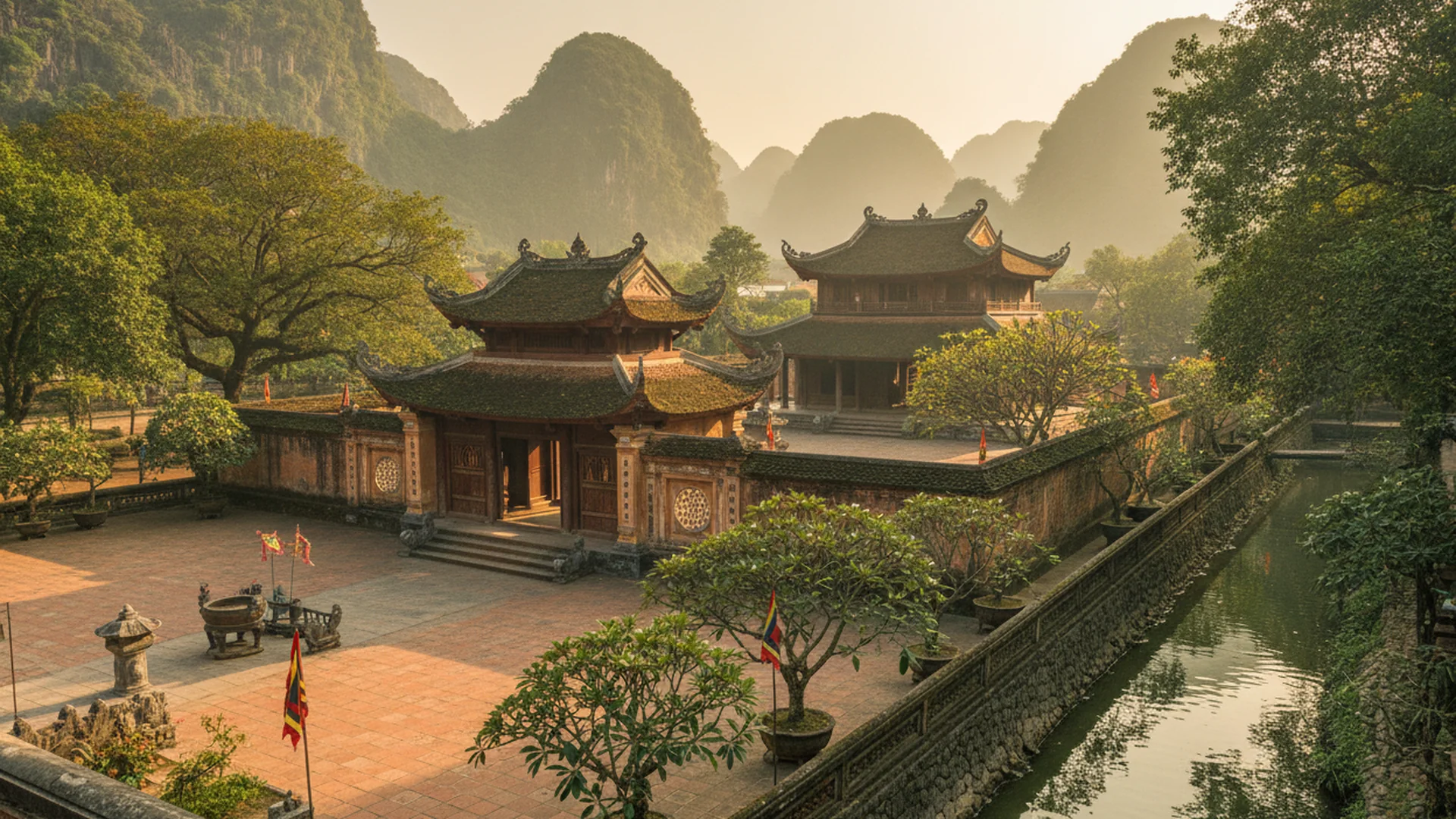
Perfume Pagoda — known in Vietnamese as Chùa Hương or Huong Pagoda — sits in Huong Son Commune, My Duc District, roughly 60–70 km southwest of Hanoi. It is not a single structure but a distributed complex of pagodas, shrines, and sacred caves carved into the limestone cliffs of Huong Tich Mountain. Key stops along the main pilgrimage route include Den Trinh, Thien Tru Pagoda, Giai Oan Pagoda, and Huong Tich Cave. The site's recorded history reaches back to the 15th century and the reign of King Le Thanh Tong; tradition holds that a meditating Buddhist monk first discovered the location, and the complex is dedicated to Quan Am — Avalokiteshvara, the Goddess of Mercy. The name itself refers to the fragrance of wildflowers and herbs that bloom across the hillsides each spring.
The Perfume Pagoda Festival, Lễ hội Chùa Hương, officially opens on the sixth day of the first lunar month and continues through the end of the third lunar month — a span that typically falls between late January and late March on the Gregorian calendar. In 2025 the festival ran from 3 February to 27 April, though exact dates shift with the lunar calendar each year and should be confirmed before travel. Attendance reaches approximately 1.5 million visitors annually, making it Vietnam's largest and longest-running Buddhist celebration. The spiritual high point comes on the 15th–20th days of the second lunar month, when pilgrims gather to commemorate the birthday of Princess Dieu Thian, considered a reincarnation of Avalokitesvara. Mid-February therefore brings the densest crowds and the most concentrated ritual activity.
The pilgrimage follows a structured sequence. Visitors board traditional wooden rowing boats at Duc Wharf for an approximately one-hour journey along the Yen Stream, passing rice paddies, limestone karsts, and forested riverbanks before reaching Thien Tru Wharf. From Thien Tru Pagoda, the ascent to Huong Tich Cave proceeds either on foot — via a trail that includes more than 1,200 stone steps, with roughly 120–150 particularly steep steps near the cave entrance — or by cable car, a 10–15 minute ride introduced to improve access for elderly and mobility-limited pilgrims. The cave itself was inscribed 'Nam Thiên Đệ Nhất Động' (First Cave Under Heaven) in 1770 and houses Buddhist statues alongside natural stalactites. Core activities throughout the festival include incense offerings, Buddhist chanting, and folk rituals inside the cave such as touching specific formations, which are traditionally believed to grant health, children, or prosperity.
Key facts & good to know
What is the Perfume Pagoda complex and what does a visit cost?
Perfume Pagoda is a Buddhist pilgrimage complex of shrines and caves in the Huong Son limestone mountains, 60–70 km southwest of Hanoi. Mandatory costs include 80,000 VND entrance, a rowboat fare, and an optional cable car. Total outlay varies by transport method.
The site is not a single building but a network of pagodas, grottoes, and shrines spread across Huong Son Commune in My Duc District. Key stops on the main route include Den Trinh (a registration shrine at the river landing), Thien Tru Pagoda (known in English as Heavenly Kitchen), Giai Oan Pagoda, and Huong Tich Cave — the spiritual core of the complex, inscribed 'First Cave Under Heaven' in 1770. Smaller pilgrimage routes (Long Van, Tuyet Son, Thanh Son) exist, though most day-trippers follow only the main Huong Tich route.
The site has been a place of Buddhist worship since at least the 15th century and is dedicated to Quan Am, the Goddess of Mercy. Cash is required for all transactions on-site; cards are rarely accepted at ticket booths, boat landings, or food stalls. Bringing small-denomination VND notes simplifies paying for boats, incense, and food separately.
Estimated total cost by visit type (per person, main Huong Tich route)
| Visit type | Transport to site | Entrance fee | Rowboat (Yen Stream) | Cable car (return) | Approx. total (VND) |
|---|---|---|---|---|---|
| DIY public bus (routes 211/78/75 from My Dinh) | ~50,000–80,000 VND | 80,000 VND | Included in group boat, ~50,000–70,000 VND | 160,000 VND (optional) | ~340,000–390,000 VND |
| Shared group day tour (Hanoi-based) | Included in tour price | 80,000 VND | Included | 160,000 VND (optional) | ~400,000–600,000 VND all-in |
| Private DMC/car tour | ~800,000–1,200,000 VND (car) | 80,000 VND | Included or separate ~200,000–300,000 VND/boat | 160,000 VND (optional) | ~1,240,000–1,740,000 VND all-in |
Rowboat pricing is per boat, typically shared among 2–5 passengers. Cable car figures are per person. All VND amounts based on published facts; tour pricing is indicative and varies by operator.
Plan a Hanoi trip
Where to stay, when to go, and how to combine the highlights of Hanoi into a paced stopover.
What is the standard route, and how much time does each stage take?
A standard visit runs 8–12 hours from Hanoi. It covers a 1.5–2 hour drive, a 1-hour rowboat ride each way, 1 hour at Thien Tru, and 15 minutes by cable car (or 1 hour hiking) to reach Huong Tich Cave.
Departing Hanoi by 7:30–8:30 AM is strongly recommended. The drive south via Ha Dong and Van Dinh to Duc Wharf takes roughly 1.5–2 hours by private car; public buses from My Dinh Bus Station (routes 211, 78, or 75) take approximately 2 hours. At Duc Wharf, visitors board traditional wooden rowing boats for the Yen Stream crossing — a roughly 1-hour ride past rice paddies and limestone karsts to Thien Tru Wharf.
From Thien Tru Pagoda, visitors have two options to reach Huong Tich Cave: the cable car (10–15 minutes one way) or a hiking trail of more than 1,200 stone steps, with the steepest 120–150 steps concentrated near the cave entrance. Even cable car users must descend those steep steps into the cave itself. Allow 45–60 minutes inside the cave complex for worship and exploration, then reverse the route for the return journey.
Stage-by-stage breakdown: Hanoi → Huong Tich Cave (one way)
| Stage | Route / mode | Approx. distance | Approx. duration |
|---|---|---|---|
| 1. Hanoi to Duc Wharf | Private car or public bus via Ha Dong / Van Dinh | 60–70 km | 1.5–2 hours |
| 2. Duc Wharf to Thien Tru Wharf | Wooden rowing boat on Yen Stream | ~3–4 km | ~1 hour |
| 3. Thien Tru Pagoda exploration | On foot | On-site | ~1 hour |
| 4a. Thien Tru to Huong Tich Cave (cable car) | Gondola cable car | Not published | 10–15 minutes |
| 4b. Thien Tru to Huong Tich Cave (hike) | 1,200+ stone steps on foot | ~2 km uphill | ~1 hour |
| 5. Huong Tich Cave visit | On foot (incl. 120–150 steep steps into cave) | On-site | 45–60 minutes |
| 6. Full return trip (boat + drive) | Reverse of stages 1–2 | ~63–74 km | 2.5–3 hours |
Total day-trip duration is 8–12 hours depending on crowd levels, pace, and lunch stop. Festival season adds time at each bottleneck.
When does the Perfume Pagoda Festival run, and how do crowds affect the visit?
The festival opens on the 6th day of the first lunar month and runs to the end of the third lunar month — roughly late January to late April. In 2025 it ran 3 February to 27 April. Peak crowds hit mid-February and on lunar 1st and 15th dates.
The spiritual climax falls on the 15th–20th days of the second lunar month, when Vietnamese Buddhists mark the birthday of Princess Dieu Thian (reincarnated as Avalokitesvara). Around 1.5 million visitors attend across the full festival period, making it Vietnam's largest and longest-running Buddhist celebration. The combination of the full-moon date, weekends, and public holidays creates the worst congestion; cable car queues exceed two hours, and the Yen Stream fills with boats moving slowly in convoy.
Inside Huong Tich Cave, the density of pilgrims on peak days makes movement slow and makes quiet prayer difficult. Weekday visits in early February or early March, arriving before 8:30 AM, reduce waiting times noticeably. Lunar calendar dates shift each year, so checking the specific Gregorian dates before booking is essential.
On lunar 1st, 15th, and mid-February peak days, cable car queues regularly exceed 2 hours and boat traffic on the Yen Stream backs up significantly. If your group includes elderly travellers or those with limited mobility, a weekday departure well before the festival climax (15th–20th of the 2nd lunar month) is strongly advised. Confirm the current year's Gregorian equivalent dates before finalising itineraries, as festival timing shifts annually with the lunar calendar.
How difficult is the hike to Huong Tich Cave, and what physical demands should visitors expect?
The full hiking trail to Huong Tich Cave covers approximately 2 km over 1,200-plus uneven stone steps. Cable car users still face 120–150 steep steps descending into the cave. Spring drizzle from January to March makes the limestone surfaces slippery.
The hiking path from Thien Tru Pagoda climbs steadily over stone steps of varying height and width. The gradient steepens sharply in the final section approaching the cave entrance, where 120–150 particularly steep steps lead downward into the grotto. There are no handrails on all sections, and the stone is worn smooth in places. Visitors who choose the cable car avoid the main ascent but still must negotiate those final steep steps — the cable car does not deliver passengers to the cave floor.
Between January and March, the Huong Son mountains receive regular drizzle. Wet limestone is significantly more slippery than it appears, and footwear with grip is a practical requirement rather than a suggestion. Flat sandals, dress shoes, and thong sandals are unsuitable for the descent into the cave. Visitors with knee problems, hip replacements, or significant mobility limitations should factor in that even the cable car option involves a physically demanding section.
Spring drizzle (January–March) makes the limestone steps at Huong Tich Cave highly slippery. Closed-toe shoes or trainers with rubber soles are required for the 120–150 steep steps into the cave. DMC operators should advise clients of this in pre-departure documentation; guides carrying a walking pole or offering assistance to older travellers on wet days is standard good practice.
What scams, tipping norms, and etiquette rules apply at Chua Huong?
Dress code requires covered shoulders and knees. Boat operators sometimes request tips mid-journey; a standard tip of 50,000 VND per passenger at journey's end is reasonable. Bring small VND denominations. Aggressive incense vendors and trailside wildlife meat displays are common.
Boat operators on the Yen Stream occasionally ask for additional payment or tips during the ride, before reaching the destination. Tipping at the end of the return journey — rather than mid-trip — keeps the arrangement straightforward; 50,000 VND per passenger is a widely cited fair amount. Paying in small notes avoids disputes over change. Incense vendors near the pagoda steps can be persistent; buying incense at the main entrance is generally simpler and cheaper than purchasing partway up the trail.
Modest dress is a practical requirement, not merely a preference: shoulders and knees should be covered for entry to the pagodas and cave. Some trailside restaurants near Thien Tru display wild animal meat, including species of uncertain legal status. Choosing established vegetarian stalls or dishes like Com Lam (bamboo-cooked rice) and Mang Chua (sour bamboo shoots) sidesteps both the ethical concern and the food-safety risk of unfamiliar bush meat. Inside the cave and at shrine areas, keeping voices low and allowing pilgrims space to pray is standard courtesy.
Can the Perfume Pagoda be combined with Quang Phu Cau Incense Village in a single day?
Yes. Quang Phu Cau Incense Village lies roughly 1 hour south of Hanoi, directly on the route to the Perfume Pagoda. Adding a 1-hour stop there is feasible with a 7:00 AM Hanoi departure, completing both sites within a 10-hour day.
Quang Phu Cau village sits along the Ha Dong corridor heading south — the same road used to reach Duc Wharf. Because it falls en route rather than as a detour, the logistical cost is low: a 1-hour visit adds roughly 1 hour to the itinerary without meaningfully extending the drive. The combination works best as a morning stop before reaching the pagoda, giving the incense village visit natural light for photography and ensuring arrival at Duc Wharf by around 9:00–9:30 AM.
A 7:00 AM departure from Hanoi is the practical threshold for making this combination work. Arriving at Duc Wharf later than 10:00 AM during festival season increases exposure to mid-morning boat queues and risks a rushed return. The drive back to Hanoi from the pagoda in the mid-to-late afternoon coincides with increasing traffic on the Ha Dong corridor, so building a 10-hour schedule with a firm departure from Duc Wharf by 3:30–4:00 PM keeps the group ahead of the worst congestion.
Hanoi attractions & tickets
Pre-purchased entrance tickets, private transfers and certified guides — no queues, no logistics hassle.
Building a hanoi itinerary for your clients?
Send us your dates and pace — we return a realistic, booked-and-paced plan with net rates, not a generic template.
Want this tailored to your dates?
We run these routes ourselves. Send your dates, group size and pace and our Hanoi team will build a custom version — with real prices, not estimates.
Frequently asked questions
People also ask
Verified sources
- ATL DMC booking log · 12,000+ trips since 2011
- Vietnam National Tourism Administration – Perfume Pagoda Festival · https://vietnam.travel/things-to-do/festival-event/perfume-pagoda-festival
- Vietnam Airlines – Perfume Pagoda Travel Guide · https://www.vietnamairlines.com/us/en/plan-book/travel/travel-guide/perfume-pagoda
- Mekong Tourism – Perfume Pagoda Festival · https://mekongtourism.org/events/perfume-pagoda-festival-viet-nam/
- Vietnam Discovery – Huong Pagoda Festival · https://vietnamdiscovery.com/hanoi/activities/huong-pagoda-festival/
- Vietnam Travel – Perfume Pagoda Sacred Site · https://vietnamtravel.com/perfume-pagoda/
- Hanoi Explore Travel – Complete Perfume Pagoda Guide · https://hanoiexploretravel.com/ha-noi-travel-guide/perfume-pagoda-vietnam
- SeniWorld – Perfume Pagoda Spiritual Journey · https://seniworld.com/perfume-pagoda/
Turn this guide into a trip
The products we actually run for this route — book direct, no OTA markup.
Plan your custom trip with Phuong Le
Phuong Le
“Tell us your dates and pace — we'll turn this guide into a realistic, booked-and-paced trip for you, not a generic template.”
Plan my trip with our team →About the authors
Phuong Le · primary author
Specialty: Hanoi · Halong Bay · Vietnam itineraries.
Cross-category lattice
Plan your trip
Practical
Related travel guides
1× per month · pillar guides + new itineraries
Get our newest pillar guides + quarterly itinerary updates delivered. No spam, no promotions, just travel-guide content. Unsubscribe anytime.