Quick answer
Morning: Royal Palace & National Museum (8:00–17:00; tickets ~$10 each). Walk to Wat Phnom (1 km). Afternoon: Tuol Sleng S‑21 ($5–8) and Choeung Ek (15 km; audio $6). Shop Central/Russian markets (7:00–17:00). Evening: Sisowath Quay or 60–90 min sunset cruise ($5–15).
Why this guide
About this guide
Phnom Penh traces its origins to around 1372, when a woman named Penh reportedly found Buddha statues washed ashore and built a temple on a nearby hill — a story that gave the city its name, meaning 'Penh's Hill.' The city became Cambodia's national capital in 1434 after the fall of Angkor, and has held that status permanently since 1865. During the French colonial period, its layered architecture — blending colonial French, New Khmer, and Art Deco styles — earned it the nicknames 'Pearl of Asia' and 'Paris of the East.' That history was violently interrupted in April 1975, when the Khmer Rouge emptied the entire city within days, leaving it largely abandoned for four years until Vietnamese forces drove the Khmer Rouge out in 1979.
Two sites document the Khmer Rouge period directly. Tuol Sleng Genocide Museum, a former high school converted into the S-21 prison between 1976 and 1979, held approximately 20,000 people — of whom only 8 survived. The Choeung Ek Genocidal Center, located 14–17 km south of the city, is where over 20,000 people were executed and buried; excavated mass graves remain visible on the grounds today. Across the Khmer Rouge's four-year rule from 1975 to 1979, an estimated two million people — roughly one quarter of Cambodia's entire population — lost their lives. Both sites are visited primarily as places of historical record and commemoration.
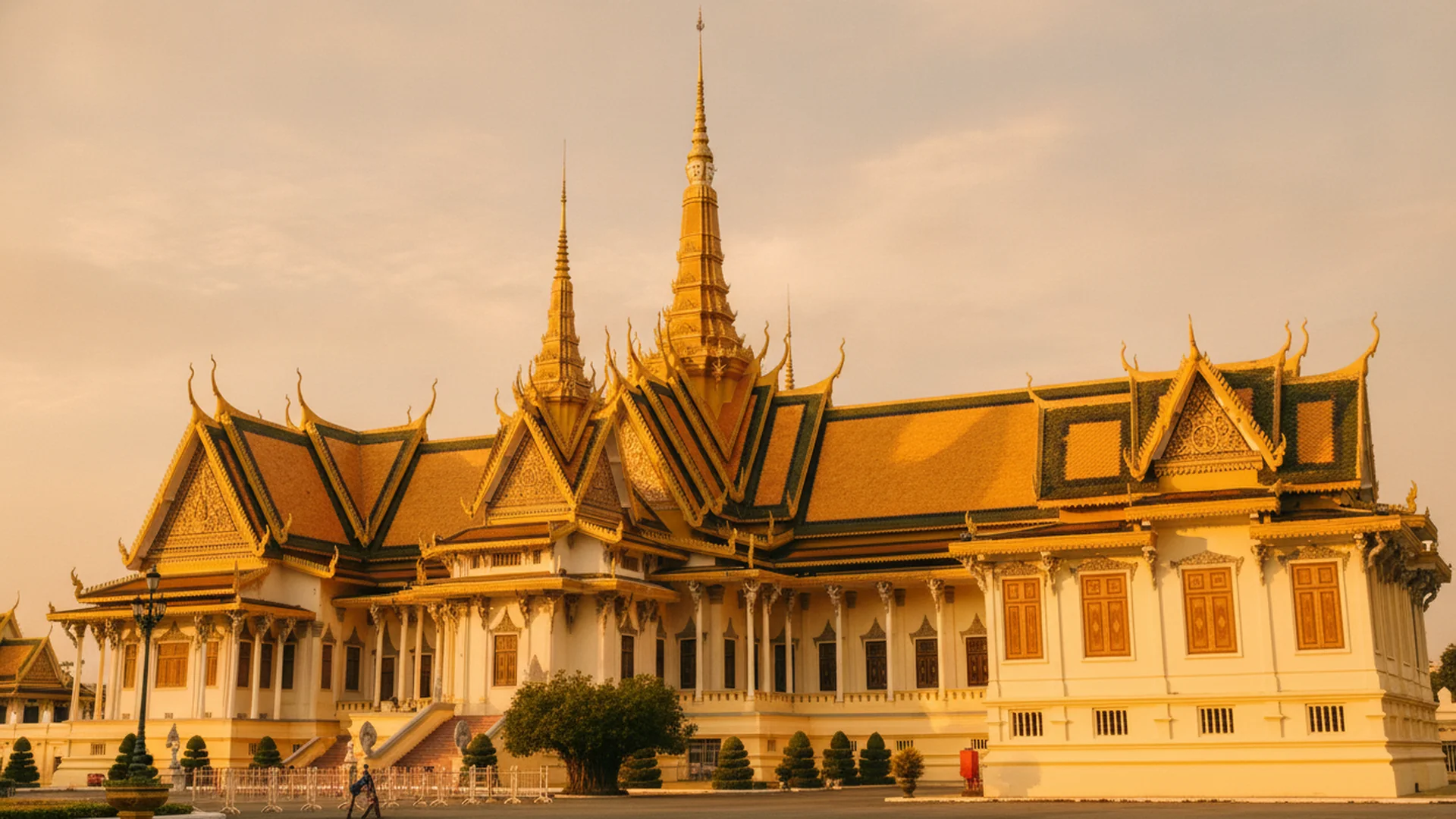
The Royal Palace, built on its current riverside site in the mid-19th century and still the official residence of King Sihamoni, opens only portions of its complex to visitors. Within its grounds, the Silver Pagoda — formally Wat Preah Keo Morakot — was originally built in wood in 1892 and rebuilt in 1962; its floor is inlaid with 5,329 silver tiles totalling 1,125 kg in weight. The pagoda's principal artifact is a life-sized gold Maitreya Buddha weighing 90 kg, set with 9,584 diamonds, with the largest stone weighing 25 carats, crafted in the palace workshops between 1906 and 1907. The complex sits along Sothearos Boulevard on the riverfront, within walking distance of the National Museum and Sisowath Quay.
Key facts & good to know
How do you navigate airport transfers and local transport in the city?
Phnom Penh International Airport (PNH) is 10 km from the city center, a journey taking 45–60 minutes in traffic. PassApp and Grab offer tuk-tuk and taxi bookings with upfront fares. Pay in USD cash or link a card to either app.
The airport sits roughly 10 km west of the riverfront, but Phnom Penh traffic—particularly during morning and evening peaks—regularly stretches that trip to 60 minutes. Official taxi counters inside the arrivals hall post fixed-rate fares; these typically cost slightly more than app-hailed rides but remove any fare negotiation. Drivers who approach unsolicited in arrivals typically charge more.
PassApp is the locally developed ride-hailing platform with the broadest driver network across the city; Grab also operates here with card-payment integration. Both apps display the fare before you confirm the booking, which is useful when you are unfamiliar with distances. Tuk-tuks are the default short-haul option for most visitors and handle typical inner-city hops in 10–20 minutes. For larger groups or luggage, hailing a taxi through either app costs roughly twice the tuk-tuk rate. Cash in USD or Khmer Riel (KHR) is accepted by all drivers; in-app card payment works on PassApp and Grab where drivers have linked accounts, though cash remains more reliable in outer districts.
Airport and city transport options: distance, time, and approximate cost
| Mode | Route | Distance | Journey Time | Approx. Fare (USD) | Payment |
|---|---|---|---|---|---|
| Official airport taxi | PNH to riverfront/city center | 10 km | 45–60 min | 12–18 | Cash (USD/KHR) |
| Grab taxi | PNH to riverfront/city center | 10 km | 45–60 min | 8–14 | App card or cash |
| PassApp tuk-tuk | PNH to riverfront/city center | 10 km | 45–60 min | 5–9 | App card or cash |
| PassApp/Grab tuk-tuk | Inner-city hop (e.g., BKK1 to riverside) | 2–5 km | 10–20 min | 2–4 | App card or cash |
| Grab taxi | Inner-city trip (e.g., BKK1 to S-21) | 3–6 km | 15–25 min | 4–7 | App card or cash |
Fares are approximate and vary with traffic, surge pricing, and negotiation outside apps. All figures in USD.
Drivers who approach visitors directly in the arrivals hall are not affiliated with PassApp or Grab and typically charge unmetered rates 2–3× higher than app fares. Book through an app before leaving the terminal building, or use the official airport taxi counter with posted fixed rates.
Plan a Phnom Penh trip
Where to stay, when to go, and how to combine the highlights of Phnom Penh into a paced stopover.
What are the entry requirements and logistics for the primary historical sites?
Tuol Sleng (S-21) and Choeung Ek are 14–17 km apart, a 40-minute drive. Both charge entry fees and offer audio guides. The Royal Palace requires covered shoulders and knees; the Silver Pagoda is inside the same complex.
Tuol Sleng Genocide Museum and Choeung Ek Genocidal Center are most efficiently combined in a single half-day. The logical sequence is to visit Tuol Sleng first—the former high school converted into a detention facility between 1976 and 1979, where approximately 20,000 people were imprisoned and only 8 survived—then travel the 14–17 km south to Choeung Ek, where over 20,000 people were executed and buried. The drive takes roughly 40 minutes depending on traffic. Audio guides are available at both sites and are worth taking; they supply context that the physical exhibits alone do not fully convey. Excavated mass graves remain visible at Choeung Ek.
The Royal Palace, built on its current riverside site in the mid-19th century, remains the official residence of King Sihamoni, so only selected sections are open to the public. The Silver Pagoda—officially Wat Preah Keo Morakot—is within the palace complex; its floor is inlaid with 5,329 silver tiles weighing 1,125 kg in total, and it houses a 90 kg gold Maitreya Buddha set with 9,584 diamonds. Both the palace and pagoda are accessible on a single entry ticket. The dress code is strictly enforced at the gate: shoulders and knees must be covered by clothing, not draped fabric or scarves. Lightweight trousers and a sleeved shirt are practical given the heat.
Historical sites: entry fees, hours, and key logistics
| Site | Entry Fee (USD) | Audio Guide | Opening Hours | Distance from Tuol Sleng | Notes |
|---|---|---|---|---|---|
| Tuol Sleng Genocide Museum (S-21) | 6 | Available (included or small add-on) | 08:00–17:00 daily | — | Former high school; 20,000 imprisoned, 8 survived |
| Choeung Ek Genocidal Center | 6 | Available (included) | 08:00–17:00 daily | 14–17 km south (~40 min) | Mass graves visible; over 20,000 executed and buried |
| Royal Palace & Silver Pagoda | 10 | Not standard | 07:30–11:00, 14:00–17:00 daily | ~3 km north of Tuol Sleng | Dress code enforced; scarves not accepted as cover-ups |
Entry fees are subject to change. Confirm current rates at each site entrance. Combined S-21 and Choeung Ek visits realistically take 4–5 hours including transit.
Gate staff will refuse entry if shoulders or knees are uncovered. Sarongs and scarves draped loosely over the body are not accepted as substitutes for proper clothing. Carry lightweight trousers and a sleeved top; vendors outside the gate sell inexpensive cover-ups, though quality varies.
Which markets sell which goods and what are their operating hours?
Central Market focuses on jewelry, electronics, and tourist goods; Russian Market sells clothing seconds, hardware, and local food; Orussey Market serves wholesale and local buyers. Most stalls close by 17:00. Price ranges vary by category and negotiation.
Central Market (Phsar Thmei) opened in 1937 and its Art Deco yellow dome—26 metres high—remains a practical navigation landmark. The central dome houses gold and silver jewelry stalls; the four radiating wings carry silk textiles, electronics, household goods, and street food. It is the market most familiar to first-time visitors and prices reflect that—expect to negotiate on watches, electronics, and tourist goods. Entry is free. Operating hours run roughly 07:00–17:00. Russian Market (Tuol Tom Poung) operates on a similar schedule and attracts a more local crowd alongside budget-conscious visitors. Its inventory leans toward clothing seconds from nearby garment factories, hardware, and a covered food section with Khmer dishes at local prices. For Kampot pepper, expect to pay around $3–6 per 100g depending on variety and whether the vendor is targeting locals or tourists; Krama scarves typically start at $2–4 for cotton versions.
Orussey Market functions primarily as a wholesale hub and is oriented toward local buyers purchasing in bulk—fabric, cookware, dry goods, and household supplies. It is less navigable for visitors who do not read Khmer price tags and is less adapted to retail transactions, but useful for understanding the scale of everyday commerce in the city. All three markets wind down by 17:00, with some food stalls at Russian Market continuing slightly later. Visiting before 09:00 at any market means cooler temperatures and less crowding.
Phnom Penh markets: inventory, hours, and typical prices
| Market | Primary Inventory | Target Buyer | Operating Hours | Sample Prices | Entry Fee |
|---|---|---|---|---|---|
| Central Market (Phsar Thmei) | Jewelry, electronics, silk, tourist goods, street food | Tourists and local shoppers | ~07:00–17:00 | Krama scarves from $2–4; watches vary widely | Free |
| Russian Market (Tuol Tom Poung) | Clothing seconds, hardware, local food, souvenirs | Local buyers and budget visitors | ~07:00–17:00 | Kampot pepper ~$3–6 per 100g; clothing from $2–5 | Free |
| Orussey Market | Wholesale fabric, cookware, dry goods | Primarily local/wholesale buyers | ~07:00–17:00 | Bulk pricing; retail transactions less common | Free |
Hours are approximate; individual stalls may close earlier. Negotiate prices at all three markets—posted prices are typically opening bids.
What is the route for exploring Sisowath Quay and the Tonle Sap riverfront?
Sisowath Quay runs roughly 3 km along the Tonle Sap from Wat Phnom in the north to the Royal Palace area. Sunset river cruises depart near the Passenger Port, run 1–2 hours, and cost $5–15 per person. The night market and street food cluster near Phsar Chas.
The walkable stretch of Sisowath Quay begins at Wat Phnom—the founding temple of the city, atop a 27-metre artificial hill—and runs south past the National Museum and Wat Ounalom to the Royal Palace on Sothearos Boulevard. The distance is approximately 3 km and the route keeps the river in view for most of it. The National Museum, housed in a terracotta Khmer-style pavilion dating from 1917, holds more than 5,000 artifacts including the sculpted head of Jayavarman VII and is a short walk from both Wat Phnom and the palace. Walking the full length in one direction takes 35–45 minutes at a moderate pace, not counting time inside any site.
Phnom Penh sits at the confluence of the Mekong, the Tonle Sap, and the Bassac rivers—a point known in Khmer as Chaktomuk, meaning 'Four Faces.' Sunset cruises departing from near the Passenger Port run 1–2 hours and offer a straightforward view of this confluence; standard ticket prices range from $5 to $15 per person depending on the operator and whether food or drinks are included. The night market (Phsar Chas) and adjacent street food stalls are located along the southern section of the quay, near the Royal Palace, and operate from early evening. Stalls here sell grilled meats, noodle soups, and fresh fruit; this area draws both locals and visitors after dark.
Which neighborhoods offer the most efficient access to sites and dining?
Daun Penh (Riverside) gives walkable access to the palace and museums but is noisy. BKK1 has international dining and is 10–15 minutes by tuk-tuk from historical sites. Tonle Bassac sits near Aeon Mall and upscale dining options.
Daun Penh, the historic district encompassing the riverfront, puts the Royal Palace, National Museum, Wat Phnom, and Sisowath Quay within a 10–15 minute walk of most guesthouses and hotels in the area. The trade-off is noise: bars and restaurants along the quay operate late, and traffic on Sisowath Quay itself is continuous through the evening. Accommodation here ranges from budget guesthouses to mid-range hotels; the proximity premium is real but so is the street-level sound. For visitors with limited days who want to minimize transit time to the main sites, Daun Penh is the most practical base.
BKK1 (Boeung Keng Kang 1), roughly 2–3 km south of the riverfront, has developed into the city's main expat residential and dining district. International restaurants, cafes, and supermarkets are dense here, and the accommodation stock includes serviced apartments and mid-range hotels with quieter streets. The tuk-tuk ride to Tuol Sleng takes around 10 minutes; to the riverfront, 10–15 minutes depending on traffic. Tonle Bassac, adjacent to BKK1, sits near Aeon Mall and a concentration of higher-end restaurants; it is slightly further from the main historical sites but practical for travelers who prioritize quieter surroundings and shopping access. Transit times from Tonle Bassac to the riverfront run 15–20 minutes by tuk-tuk.
Neighborhood comparison: access, noise, and price tier
| Neighborhood | Walk to Royal Palace | Tuk-tuk to S-21/Choeung Ek | Tuk-tuk to Riverfront | Noise Level | Accommodation Tier | Key Advantage |
|---|---|---|---|---|---|---|
| Daun Penh (Riverside) | 5–15 min walk | 15–25 min | 0–10 min (walkable) | High (bar/traffic noise) | Budget to mid-range | Walkable to all riverside sites |
| BKK1 | 10–15 min tuk-tuk | 10–15 min tuk-tuk | 10–15 min tuk-tuk | Low to moderate | Mid-range to upscale | International dining; quieter streets |
| Tonle Bassac | 15–20 min tuk-tuk | 15–20 min tuk-tuk | 15–20 min tuk-tuk | Low | Mid-range to upscale | Near Aeon Mall; upscale dining |
Transit times are estimates in normal daytime traffic and will increase during peak hours or during events such as the Water Festival.
When is the dry season and how do local events affect travel logistics?
The dry season runs November to April, with temperatures of 25–35°C. The Water Festival (Bon Om Touk) in November brings millions of domestic visitors, closes riverfront roads, and fills hotels. The wet season (May–October) brings afternoon rain that affects outdoor sites.
November to April is the driest period, with daytime temperatures typically between 25°C and 35°C. March and April are the hottest months; November and December offer the most manageable combination of dry conditions and lower temperatures. During the wet season (May–October), rainfall follows a predictable afternoon pattern rather than all-day downpours, but outdoor sites like Choeung Ek become muddy and less accessible after heavy rain. The mass graves and open memorial areas at Choeung Ek have limited covered sections, so wet-season visits there are better planned for mornings.
The Water Festival (Bon Om Touk) falls in November and celebrates the Tonle Sap River's annual flow reversal—the phenomenon where the swelling Mekong pushes water back upstream into Tonle Sap Lake, expanding it from roughly 2,500 km² to over 16,000 km². The festival draws millions of domestic visitors to Phnom Penh for boat races along the riverfront near the Royal Palace. During this period, major sections of Sisowath Quay and adjacent riverfront roads are closed to vehicles, requiring significant detours for tuk-tuks and taxis. Hotel occupancy reaches its peak across all districts; booking accommodation several weeks in advance is necessary to secure standard rates. Visitors already in the city during the festival should build 20–30 extra minutes into any cross-city transit plan.
During Bon Om Touk in November, riverfront road closures force all vehicle traffic onto inland routes, significantly extending tuk-tuk and taxi journey times across the city. Hotel occupancy peaks city-wide; rooms at standard rates are difficult to secure without advance booking. If your travel dates overlap with the festival, confirm your accommodation and plan extra transit time for all journeys through or near the riverfront.
Phnom Penh attractions & tickets
Pre-purchased entrance tickets, private transfers and certified guides — no queues, no logistics hassle.
Building a phnom-penh itinerary for your clients?
Send us your dates and pace — we return a realistic, booked-and-paced plan with net rates, not a generic template.
Want this tailored to your dates?
We run these routes ourselves. Send your dates, group size and pace and our Hanoi team will build a custom version — with real prices, not estimates.
Frequently asked questions
People also ask
Verified sources
- ATL DMC booking log · 12,000+ trips since 2011
- Wikipedia – Phnom Penh · https://en.wikipedia.org/wiki/Phnom_Penh
- Tourism Cambodia – Central Market (Phsar Thmei) · https://www.tourismcambodia.com/travelguides/provinces/phnom-penh/what-to-see/25_central-market-phsar-thmei.htm
- Wikipedia – Silver Pagoda · https://en.wikipedia.org/wiki/Silver_Pagoda
- Wikipedia – Tonlé Sap River · https://en.wikipedia.org/wiki/Tonl%C3%A9_Sap_River
- Wikipedia – Mekong River · https://en.wikipedia.org/wiki/Mekong
Turn this guide into a trip
The products we actually run for this route — book direct, no OTA markup.
Plan your custom trip with Phuong Le
Phuong Le
“Tell us your dates and pace — we'll turn this guide into a realistic, booked-and-paced trip for you, not a generic template.”
Plan my trip with our team →About the authors
Phuong Le · primary author
Specialty: Hanoi · Halong Bay · Vietnam itineraries.
Cross-category lattice
Plan your trip
Practical
Related travel guides
1× per month · pillar guides + new itineraries
Get our newest pillar guides + quarterly itinerary updates delivered. No spam, no promotions, just travel-guide content. Unsubscribe anytime.